How-To Guides
Cold Brew Season: The Real Recipe (And Why Yours Tastes Watery)
Twenty-four hours, the right grind, and a coffee that wasn't designed for hot extraction. The full case for a cold-brew method that's been hiding in plain sight.
Cold brew season is upon us. Within the next two weeks, every cafe in North America will pivot its menu to feature a cold brew tap, the espresso volume will drop and the iced volume will spike, and an enormous percentage of home brewers will pull out their Toddy or their half-gallon Mason jars and produce coffee that tastes, against the grain of all their effort, kind of bad.
This is unnecessary. Cold brew at home, done correctly, is the most effort-light brewing method that can produce a genuinely great cup. The issues are almost always the same three things — wrong ratio, wrong time, wrong coffee — and once you fix them, you can make a half-gallon of cold brew on Sunday that lasts a full work week and gets better every day.
Here's the actual recipe and the reasoning behind it.
Why most home cold brew is weak
Cold brew is an extraction method that uses time instead of heat to pull soluble compounds out of coffee grounds. The standard hot-brew extraction completes in 3–5 minutes because the high water temperature (90°C+) accelerates the diffusion of soluble flavors out of the grounds. Cold brew uses ambient or refrigerated water (4–22°C, depending on whether you steep on the counter or in the fridge) and replaces heat with duration: 12 to 24 hours of contact.
The first place most home recipes go wrong is duration. The internet recipes are all over the map. "Steep for 8 hours." "12 hours." "Overnight" (which could mean 6 or 14 depending on when you go to bed). The 8-hour recipe is too short for most ratios, and produces under-extracted, watery cold brew. 12 is closer but still on the short side. The recipe that actually works is 18–24 hours, with diminishing returns past 24.
The second place is ratio. Most home recipes use 1:8 (one part coffee to eight parts water), which is the right ratio if you're making a concentrate to dilute later. A lot of people use 1:8 and then drink it neat, which produces an over-extracted, harsh cup. Or they use 1:16 and drink it neat, which produces a thin, watery cup. The right ratio depends on whether you're drinking it concentrated, diluted, or neat.
The third is coffee selection. Most people use whatever bag is on the counter. This is fine if the bag is medium or medium-dark. It's not fine if the bag is a $24 single-origin natural Ethiopian, which is too delicate and too expensive for cold brew to do justice to. Cold brew rewards medium and medium-dark roasts, washed Latin Americans, and traditional espresso blends. It punishes light-roast single-origin lots that were designed for V60 extraction.
The recipe
For a 64-oz / 1.9-liter Mason jar (the half-gallon size most home cold brew uses):
Coffee: 175g of medium or medium-dark roast coffee. Washed Colombia, washed Brazil, washed Honduras, or a traditional espresso blend. Avoid light-roast Ethiopian/Kenyan single-origins — save those for V60.
Grind: Coarse. Coarser than French press. You want grinds that look like sea salt, not table salt. On a Baratza Encore, that's around setting 32–35. On a hand grinder, 30–35 clicks open from the closed position depending on your specific grinder.
Water: 1500g (1.5L) of filtered water at room temperature. Roughly a 1:8.5 ratio. This produces a moderately concentrated brew that you'll dilute slightly with ice when serving.
Time: 18–22 hours total contact time, in the refrigerator. The 18-hour mark is when you start having a cup that's recognizably cold brew; the 22-hour mark is the peak for most coffees. Past 24 hours, the cup starts gaining bitter notes and losing some of the brightness.
Process:
- Grind the coffee coarse. Add it to the jar.
- Pour 1500g of room-temperature filtered water over the grounds. Use the kettle from your normal pour-over routine — same water, just don't heat it.
- Stir gently with a long spoon to wet all the grounds. Some grounds will float; that's fine. Don't agitate aggressively.
- Cover the jar with a lid (loose, not airtight) or with a coffee filter held on with a rubber band.
- Refrigerate.
- After 18–22 hours, set up a coarse filter (Aeropress filter cone with paper filter, French press mesh, or a fine-mesh strainer with a paper coffee filter inside) over a clean half-gallon container.
- Pour the cold brew through the filter slowly. The first pass through grounds will be cloudy; the paper filter clears it. Don't squeeze or press the grounds — just let it drain naturally.
- Discard or compost the grounds. Refrigerate the filtered cold brew. Drink within 5 days.
Serving
The brew you've made is moderately concentrated. Three serving styles:
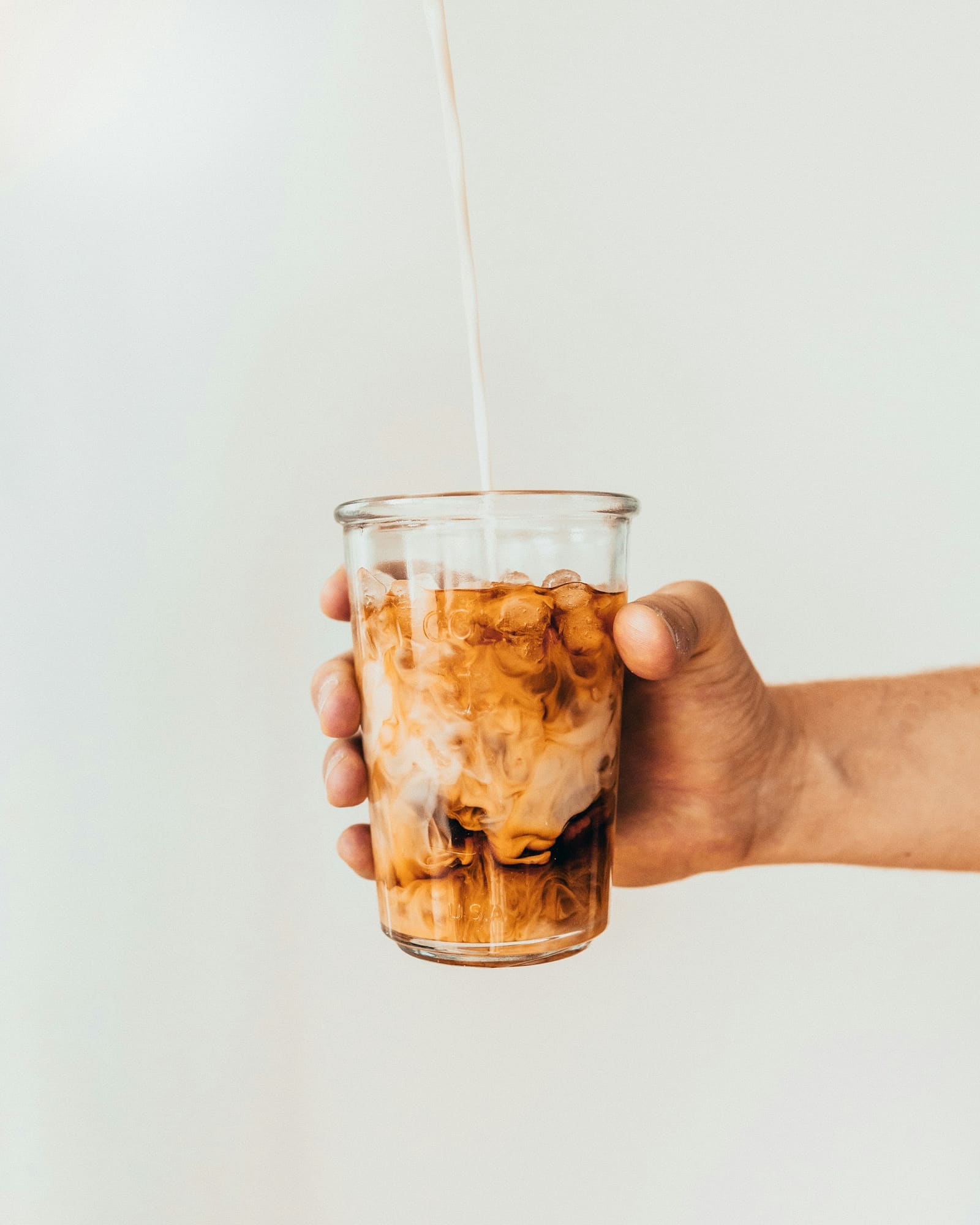
Neat over ice: Pour 6–8 oz of cold brew over a tall glass of ice. The ice will dilute slightly as it melts. This is the everyday serving — strong, clean, slightly bitter on the finish but balanced overall.
Diluted with water: 1:1 cold brew to cold water, served over ice. Lighter cup, more like an iced coffee than concentrated cold brew. Useful if you find the neat version too strong.
Cold brew with milk: 4 oz cold brew, 4 oz milk (oat milk works exceptionally well), over ice. The cold brew's natural sweetness, especially when it's been brewed from a medium-roast Colombian, integrates beautifully with milk in a way that hot iced coffee often doesn't.
For a stronger cup with the same ratio, refrigerate for closer to 24 hours. For a lighter cup, refrigerate for closer to 18.
Why coffee selection matters more than equipment
The single most overlooked variable in home cold brew is the coffee. People obsess over Toddy vs. Mason jar, mesh filter vs. paper, precision grinder vs. hand grinder. None of it matters as much as choosing the right bag of beans.
Cold brew works by extracting soluble compounds slowly without the heat that normally accelerates extraction. The compounds that come out most easily in cold extraction are the heavier, more chocolate-forward, more body-driving flavors. Light, bright, citrus-forward flavors that define great hot-brewed Ethiopian or Kenyan coffees largely don't come through in cold extraction — they require heat.
A light-roast Yirgacheffe brewed cold tastes like a faint suggestion of itself. A medium-roast Colombian or a traditional espresso blend brewed cold tastes rich, sweet, and full-bodied — exactly the cold brew experience most people are after.
This means: don't waste your $26 single-origin natural Sidamo on cold brew. Drink it on V60, where the volatile aromatics survive. Use a $14 medium-roast Colombian, a $16 traditional Italian-style espresso blend, or a $18 medium-dark Brazil for cold brew. The cup will be better, and you'll save money.
If you want to spend more on cold brew, look for explicit "cold brew lots" that some specialty roasters now release — these are typically slightly darker roasts of washed Latin American or African coffees, optimized for cold extraction. Counter Culture, Onyx, and Joe Coffee all sell these in summer.
What about hot bloom cold brew?
A growing trend in cold brew recipes is the "hot bloom" — pour a small amount of hot water (90°C+) over the grounds first, let them bloom for 30–60 seconds, then add the rest of the cold water. The theory is that the brief hot-water exposure releases volatile aromatics that pure cold extraction misses, while preserving the cold-brew character of the rest of the brew.
I've tested this side by side multiple times. The hot-bloom cold brew is genuinely different — slightly more aromatic, with a bit more brightness on the front end. Whether it's better is a matter of preference. I personally prefer the cleaner, smoother profile of fully cold extraction. If you've been making cold brew for a while and want to experiment, try the hot bloom on a Colombian or Honduran and compare.
Storage and shelf life
Cold brew, once filtered, keeps in the refrigerator for about 5 days at peak quality. After that, it doesn't go bad in a food-safety sense for at least another week, but the flavor flattens and develops a slight stale-cardboard note. Drink within 5 days for the best experience.
Some recipes call for storing the unfiltered grounds in the brew for the full 5 days. Don't. The continued contact extracts harsher compounds, and the cup gets bitter and astringent within 36–48 hours. Filter at the 18–24 hour mark and store the brew without grounds.
The half-gallon weekly rhythm
A half-gallon (1.9L) of cold brew at the recipe above produces about 12–14 servings of 6-oz cold brew over ice, or 16–18 servings of 4-oz cold brew with 4-oz milk. That's an entire work week for one person, or 3–4 days for two.
The rhythm I've settled into: brew on Sunday afternoon. Filter on Monday morning. Drink Monday through Friday. Brew again the following Sunday. The total active labor is maybe 15 minutes per week — five minutes to grind and load, ten minutes to filter. The yield is genuinely excellent coffee for the entire workweek without any morning effort.
This is, in the end, what makes cold brew worth the time investment: it's the only brewing method that scales to a week's worth of coffee in a single batch and still tastes good every day. The first cup is excellent. The fifth cup is excellent. The cup you grab on the way out the door at 7am Tuesday is the same cup you would have made deliberately at 9am Saturday.
That's the appeal. Get the ratio, the time, and the coffee right, and cold brew is the most effort-light excellent coffee you'll make all summer.
Sunday afternoon. Coarse grind. Filtered water. Lid on. Twenty hours. The week takes care of itself.