Gooseneck Kettle Shootout 2026: Five Contenders, One Winner
Pour control, temperature accuracy, and the things you only notice after six months. The Stagg EKG, Brewista Artisan, Cosori, Bonavita, and a $35 dark horse, ranked.
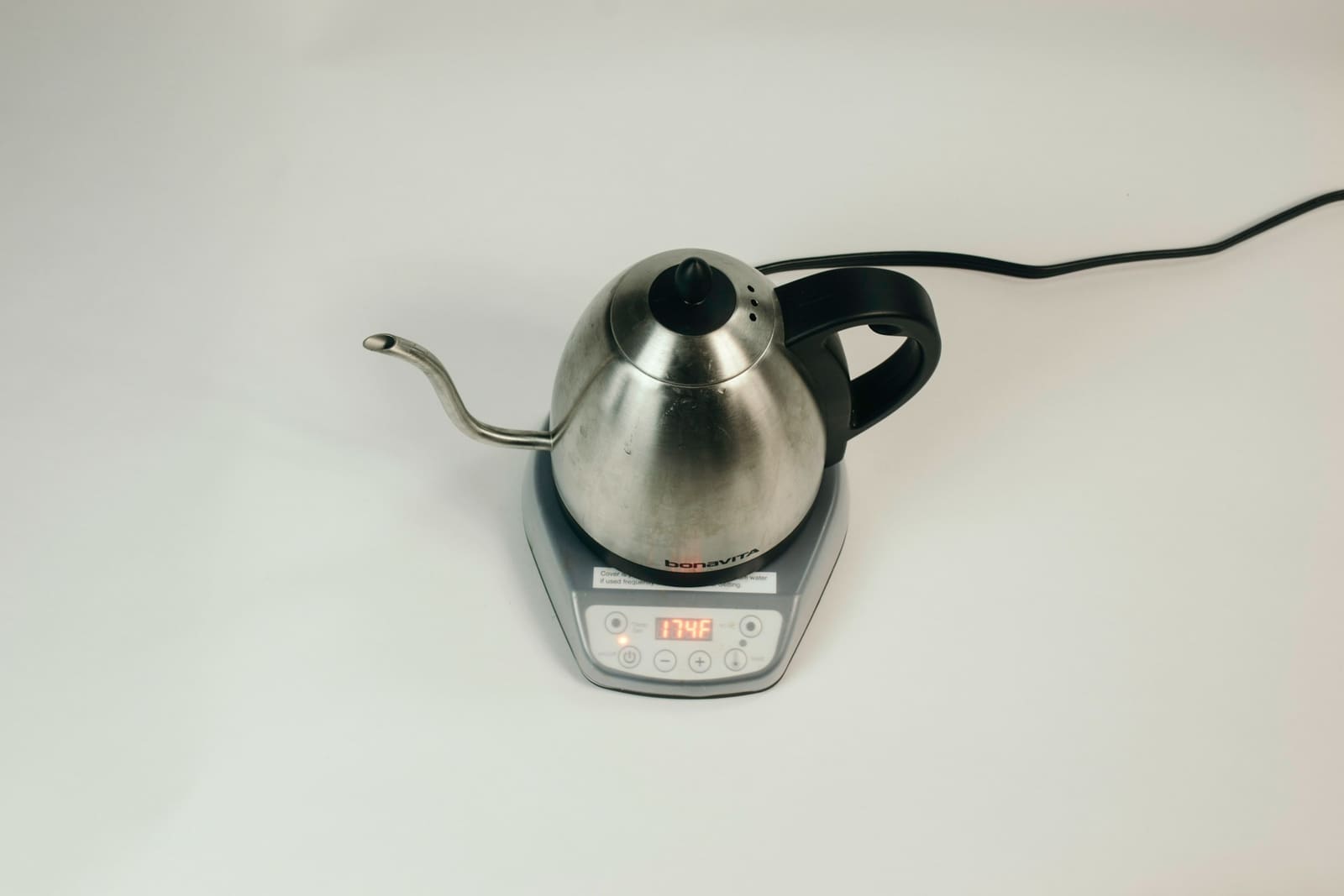
A gooseneck kettle is the most boring piece of coffee gear you will ever buy and also one of the most consequential. The kettle controls pour rate, water temperature, and ergonomics — the three things that determine whether your morning V60 is a thoughtful brew or a rushed one. Spend $30 too little and you'll fight the kettle every morning. Spend $200 too much and you'll feel ridiculous about it.
I've spent the last three months alternating five gooseneck kettles on the same counter, with the same beans, the same scale, the same V60. Here's what they actually do, what they actually cost, and which one I'm keeping.
What we tested for
Pour rate at the spout — measured by pouring 100g of water and timing the smallest controlled stream the kettle could produce, then the largest. The range matters. A kettle that can only do "medium pour" loses to one that can throttle from a thread to a flood.
Temperature accuracy — measured against a calibrated digital thermometer (ThermoWorks ThermaPen) at 92°C, 96°C, and 100°C set points. A kettle that says 96°C and pours 92°C is cooking at the wrong temperature for the entire brew.
Hold time — how long the kettle maintains target temperature with the lid on, no power. Relevant for batch brewing or when life intervenes between bloom and the rest of the pour.
Ergonomics over 90 days — handle balance when full, weight when empty, whether the cord gets in the way, whether you can see the temperature display from above without leaning. The unglamorous stuff that compounds.
The contenders
Fellow Stagg EKG — $195. The bench mark. Variable temperature 57–100°C, full PID, hold function, 60-min auto-off, swivel base, gooseneck designed by the brand that turned coffee gear into furniture.
Brewista Artisan Variable Temperature Kettle — $115. The serious-tools alternative. Variable temperature, hold function, count-up timer (which the Stagg lacks at this generation), 600ml capacity vs. the Stagg's 900ml.
Cosori Pour Over Kettle — $80. The mid-range proposition. Variable temperature in 5°C increments, hold function, 800ml capacity. Cosori is mostly known for air fryers.
Bonavita Variable Temperature 1L — $90. The classic. The kettle that introduced most home brewers to gooseneck pour control a decade ago. Still in production, still serviceable, no display screen — just a dial.
OXO Brew Adjustable Temperature — $35. The dark horse. No PID, no hold function, no display. Adjustable temperature via a mechanical dial. Half the price of every other kettle here.
Pour rate and control
This is the category that separates a kettle from a wallet drainer.
The Stagg is excellent. The narrow gooseneck and counterweighted handle let you produce a thread-thin stream that lasts 30+ seconds for an aggressive bloom, or open up to a steady, fast pour. The handle pivot puts the spout at exactly the angle your wrist wants it. There is a reason this kettle is the default in serious cafes' brew bars.
The Brewista is also excellent and arguably better at the very low end of pour rate — its spout produces an even tighter thread than the Stagg's. The slightly smaller capacity makes it more wieldy for single-cup pours; less so when you're brewing a 1L Chemex.
The Cosori is good. Not great. The spout is shorter than the Stagg's and the pour starts to break into droplets at the slowest rate, where the Stagg holds a continuous thread. Functional for everyday filter, slightly clumsy for very slow blooms.
The Bonavita is fine. The spout is longer than the Cosori but lacks the precision of the Stagg or Brewista. You can pour a clean, steady stream at medium rates. Very slow pours wobble.
The OXO, surprisingly, pours competently. The spout shape is close enough to Stagg's that the pour rate range is similar — you can produce both a thread and a flood. Stream stability at the very slowest pour isn't quite as good, but it's noticeably better than the Cosori or Bonavita.
Temperature accuracy
I tested each kettle by setting it to 96°C, letting it complete heating, then immediately reading the spout output with the ThermaPen. Three trials per kettle.
Stagg — averaged 95.4°C against a 96°C target. The most accurate of the bunch. Brewista — averaged 95.1°C. Functionally identical to the Stagg. Cosori — averaged 93.8°C. Two full degrees low. Noticeable in the cup with light roasts. Bonavita — measured by dial position, no digital readout. The "200°F" detent produced 91°C / 196°F. Three degrees low and not adjustable. OXO — also dial-based, no PID. The "200°F" position produced 92°C / 198°F. Two degrees low.
The Stagg and Brewista are the only kettles in this group I'd trust for temperature-sensitive brewing without an external thermometer. The Cosori, Bonavita, and OXO all run cold by 2–3°C, which translates to consistent under-extraction on light roasts.
The fix for the cheaper kettles: set them 2–3°C higher than your target. The Cosori at 98°C set produces actual 96°C output. This works but adds friction to every brew.
Hold time
Set to 96°C, lid on, base disconnected, kettle on counter at 22°C ambient.
Stagg held within 2°C of target for 22 minutes. Insulated body, narrow opening. Brewista held within 2°C for 18 minutes. Cosori held within 2°C for 14 minutes. Bonavita held within 2°C for 11 minutes. OXO held within 2°C for 9 minutes.
Hold matters more than people realize. If you bloom a V60 at 96°C and pour the rest of the brew over the next three minutes, you want the water in the kettle to still be 96°C at the end. Most pour-over recipes assume constant temperature; in practice, every kettle except the Stagg drops a degree or two over a single brew. The Stagg's insulation is genuinely a meaningful feature, not just a luxury.
What I noticed at month three
After 90 days, the kettles separated themselves on things I hadn't planned to test.
The Stagg's swivel base is the single best feature of any kettle in this group. The kettle rotates 360° on the base — you don't have to lift it to reposition the handle. Once you've used it for a week, picking up a non-swivel kettle feels archaic.
The Brewista's count-up timer (the digital readout shows seconds elapsed since the kettle came on) is genuinely useful for batch brewing where the bloom-to-pour timing matters. You don't need a separate timer next to the brew bar.
The Cosori's lid is loose-fitting and rattles when full. After a month of this I started leaving the lid off, which obviously defeats hold time.
The Bonavita's handle gets uncomfortably warm during heating. Not dangerous, but you notice it.
The OXO is the only kettle in this group whose handle is plastic on a metal stem with no detectable thermal issues. The mechanical thermostat clicks audibly when the kettle reaches set temperature. After 90 days the click was reassuring, not annoying.
The verdict
The Stagg EKG is the best kettle in this test, full stop. Best pour control, best temperature accuracy, best hold time, best ergonomics. If money is no object and you brew pour-overs daily, buy the Stagg. The fact that it costs $195 is the only thing keeping me from recommending it to everyone.
The Brewista Artisan at $115 is 90% of the Stagg for 60% of the price. Better at the very slowest pour rate, marginally smaller capacity, count-up timer is a thoughtful touch. If the Stagg feels excessive but you want serious pour control and accurate temperature, the Brewista is the right buy.
The OXO Adjustable at $35 is the upset of the test. It loses on temperature accuracy (set 2°C high to compensate), loses on hold time, loses on swivel base. But the pour control is unexpectedly good and the price is one-fifth of the Stagg. For someone starting out, learning whether they care about pour-over enough to justify a $200 kettle, the OXO is the right entry point.
The Cosori and Bonavita I can't recommend over the OXO. They cost two to three times as much for marginally better temperature stability and worse pour control. The Cosori in particular feels like an air-fryer brand making a kettle, which is precisely what it is.
My personal pick after 90 days: the Brewista Artisan. The Stagg is better, but the Brewista's slightly tighter low-end pour is genuinely useful for the slow blooms I do on Ethiopian washed coffees, and saving $80 buys a lot of bags. Your mileage may vary.
The kettle is one of those pieces of gear that becomes invisible when it's right. You stop noticing it. You just brew. The Stagg, Brewista, and OXO all disappear after a few weeks. The other two never quite did.